Art of Chaos: Dr. Nicole Dolan
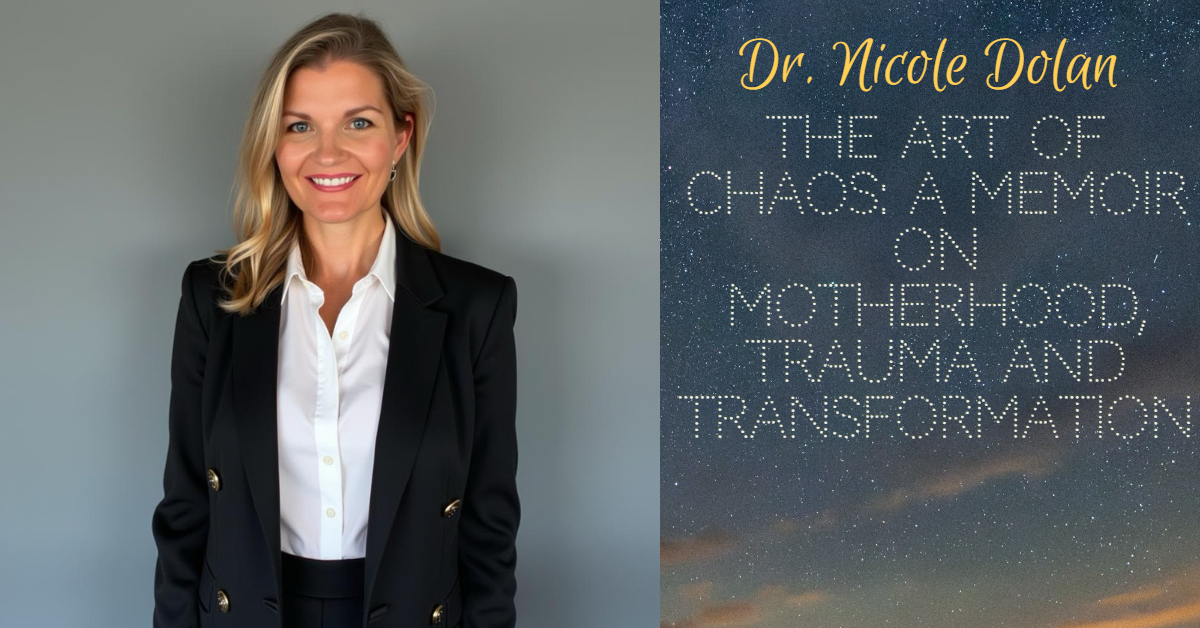
Dr. Nicole Dolan, is the author of The Art of Chaos: A Memoir on Motherhood, Trauma and Transformation which will be published soon.
Dr. Nicole Dolan is a licensed therapist who takes a holistic approach to healing—integrating mind, body, and soul. While she uses the medical model when needed, her deeper work explores the spiritual journey of self-discovery and transformation, often sparked by trauma. She believes in moving clients beyond crisis and survival toward thriving—mentally, emotionally, and spiritually. Her areas of focus include trauma recovery, PTSD, neurodiversity in children, narcissistic abuse, relational issues, motherhood, grief, spiritual growth, and energy healing.
Four Columns considers it an honor to interview Dr. Nicole Dolan.
Your book is titled The Art of Chaos. What does that phrase mean to you, and how did you come to see chaos as an art form rather than just disorder or pain?
For me, The Art of Chaos means wholeness. It’s not about fixing the mess, but becoming whole within it. I’ve always looked for meaning in hard things—that’s how I’m wired. But when I became a mother, especially to a neurodivergent child, everything I thought I knew about healing changed. I didn’t have space to fall apart and process things the old way. I had to live the work right in the middle of it all: meltdowns, grief, exhaustion, beauty. Chaos became a crucible. The art wasn’t in controlling it. It was in learning to stay present, to find rhythm, and to let something new be born through it. That’s when it stopped feeling like something to survive and started to feel sacred.
You write about your world falling apart—can you share one pivotal moment that sparked your journey toward healing and transformation?
As depth psychologists, we work with story—myth, metaphor, personal narrative. For years, I lived by the Hero’s Journey. I had followed it, taught it, guided others through it. So when motherhood and trauma collided; I kept waiting for the mentor to arrive. I begged my guides fora sign, said I was ready. But no one came. Then one day, in the middle of the screaming and unraveling, I realized I wasn’t in that story anymore. I was in the Heroine’s Journey. This wasn’t about slaying dragons. This was about turning inward, surviving the descent, and finding home within myself. That shift changed everything. It was the beginning of embodiment.
As a depth psychologist, how did your academic and clinical background influence your personal process of reclaiming wholeness?
Depth psychology asks, “What does the soul want?” That question shaped everything for me. I didn’t just look at my daughter’s struggles. I asked, what is this awakening in me? My training helped me recognize ancestral threads, soul contracts, the meaning inside the mess. But eventually, I had to admit that insight alone wasn’t enough. I had to let go of theory and go deeper—into the body, into the unknown. Healing, for me, became an integration of all things: biomedical and mystical, sensory and spiritual. I stopped splitting between the clinical and the intuitive. I honored both. And when I did, I shifted. My daughter did too. Wholeness came from that place.
Many readers face invisible battles. What advice do you have for those who feel unseen or unheard in their struggles?
The first words that come through are: go within and trust. Being human is hard, and sometimes invisible pain is the heaviest to carry. If you feel unseen, find a mirror—someone who can witness your truth and reflect it back to you. That might be a therapist, a mentor, or a friend who really sees you. We weren’t meant to do this alone. The world has taught us to carry it all quietly, but healing begins when we give our pain a name, a voice, and a place to land. I believe trauma can open us, not just break us. That relationships can be sacred mirrors. That where there is rupture, there can be repair. Presence and connection begin when we stop abandoning ourselves.
Parenting neurodivergent children comes with unique challenges and rewards. How has this experience shaped your understanding of resilience, both in yourself and in your daughter?
Parenting a neurodivergent child has been the hardest thing I’ve ever done. From the beginning, my daughter felt everything—loudly, deeply, overwhelmingly. I thought I was failing. The meltdowns, the transitions, the isolation brought me to my knees. But over time, I began to see her more clearly. She’s intuitive, soulful, fierce. She’s known things I couldn’t explain. I used to think I was here to guide her but I’ve come to understand we chose each other. At a retreat for mothers of Autism/ADHD children recently, I shared this truth with the group and I meant it, “These children choose incredibly special people as parents.” That day, I saw my own reflection clearly. I feel deeply. I get overstimulated. I carry gifts that once felt like burdens.
Our resilience isn’t just survival—it’s magic. It’s living in a different rhythm, and realizing that difference is sacred.
You describe your book as being for “all seekers and survivors.” What do you believe is the common thread among those who identify as both?
Seekers and survivors often walk hand in hand. Those of us who’ve known deep pain tend to ask deeper questions. I’ve seen this in my clients—and in myself. People who feel life intensely often experience more wounding, but also more awakening. I believe many of us were born sensitive, wired for both the ache and the wonder. Our pain initiates us. It invites us inward, into mystery, into remembering. We may not choose the path, but once we’re on it, something sacred begins to unfold. The common thread is this: we were made for the liminal. We’ve been to the underworld and back. And we carry a light that others can feel, even if they don’t understand it.
What role does spirituality play in your healing journey—and how do you define spirituality in your own life?
Spirituality is everything to me. And for a long time, I was told to keep it out of the room—as a therapist, as a professional. But that never resonated. I believe our spiritual beliefs shape how we heal. My own awakening began at 30 with a moment I can only describe as hearing a voice from the sky. After that, my life opened. Intuition led the way. Things began to align. I often say there’s a difference between believing and knowing. Once you know you’re not alone, you don’t go back. For me, spirituality is connection—to people, to the earth, to something more. I believe in soul contracts, karma, sacred mirrors. I find spirit in silence, in nature, in my children’s eyes.
Spirituality means trusting what I feel and knowing that life is always speaking. I just have to listen.
As someone who’s also an entrepreneur, how do you balance personal authenticity with professional responsibilities, especially when dealing with trauma and transformation publicly?
Living spiritually means trusting in every space—not just in a mountaintop meditation or in a lotus field in Thailand during a monsoon, but in boardrooms, emails, and contracts too. Over time, I’ve learned to listen to my body above all. After years of mind-body-soul work, I don’t ignore alignment. If something feels off, I trust that. Even if it looks great on paper. I made a promise years ago, that I wouldn’t make life decisions based on money. That promise keeps me honest. I’m also not afraid to be public with my truth. I spent years thinking I was too much, too intense. But when I stopped abandoning myself, I saw that my truth was my offering. I don’t perform. I live it. And when I do, the right people find me. That’s how I stay aligned—by staying real.
In a world that often rewards productivity over presence, what practices help you stay grounded and connected to your truth?
I’ve never really subscribed to the culture of constant productivity. Even as a kid, I questioned everything—religion, systems, timelines. I remember graduating high school and refusing to choose my life from a catalog. I’ve always been a bit of a rebel that way. But I have been busy. I’ve had to work at presence. Especially in motherhood. When I come home from work, I put my phone away. I make space for slowness. My real grounding practice, though, has been embodiment. All the healing work I’ve done—somatic, ancestral, spiritual—has helped me be here, in my body, not just my mind. Presence lives in the body. And truth lives in presence. I no longer leave myself for others. If you’re disconnected from your truth, notice where you’re abandoning yourself. Start there.
You’ve dedicated over a decade to writing and reflecting on healing. What has surprised you most about your own growth during this process?
What’s surprised me most is that all the healing brought me home. Over 14 years ago, a beloved mentor welcomed me into this work by saying, “Welcome home.” I didn’t know what that meant then. Now I do. I’ve walked through PTSD, betrayal, grief, and the kind of pain that makes time slow to a crawl. I thought healing would lead me to a new life—and in many ways it did. But more than anything, it brought me back to myself. Back to my daughter. My mother. Even my grandmother, who I never knew. I began to see that even the painful parts weren’t rejections, but reflections. I was always loved. Always chosen. Even when it didn’t feel that way. That’s the wholeness I didn’t expect—but it’s what I live for now.
As a woman who has endured and risen through chaos, what does women’s empowerment mean to you today—and how do you think your book contributes to that larger movement?
To me, empowerment is remembering who you are. It’s reclaiming the parts you were told to dim—your sensitivity, your fire, your knowing. For years, I tried to be good. To hold it all together. But chaos stripped that away. Motherhood, trauma, neurodivergence—they asked me to stop performing and start embodying. The Art of Chaos adds to the movement by telling the truth. It says: you are not too much. You are not broken. You are not alone. I wrote it for the women navigating mess and magic, grief and grace. It’s a reminder that power doesn’t wait on the other side of healing. It lives inside the mess.
If you could leave readers with one message from The Art of Chaos, what would it be?
You are a sacred being, and this is a sacred life. I wrote this book as an offering—for others to come home to their own story. When we stop holding our past in fragments and begin honoring the whole of who we are, we reconnect—with self, with others, with spirit. What once felt like broken pieces—grief, trauma, memory—starts to take shape. Like stained glass, each shard finds its place. That is the art. That is the transformation. Many people search for their purpose. I believe your purpose is your story. When you give every part of it a place, even the chaos becomes creation. Even the pain becomes meaning. Even the broken becomes whole.
Loved the interview.
Dr. Nicole provides an honest, in depth look into her journey.
It’s quite profound, raw and she seems to be really enjoying all the
Aspects of this journey.
Thanks Jerry for another good one. Now awaiting something on Dr. Abraham Verghese ‘Covenant of Water’. Love from India.