
Refined By Fire: A Memoir of Loss, Faith and Becoming
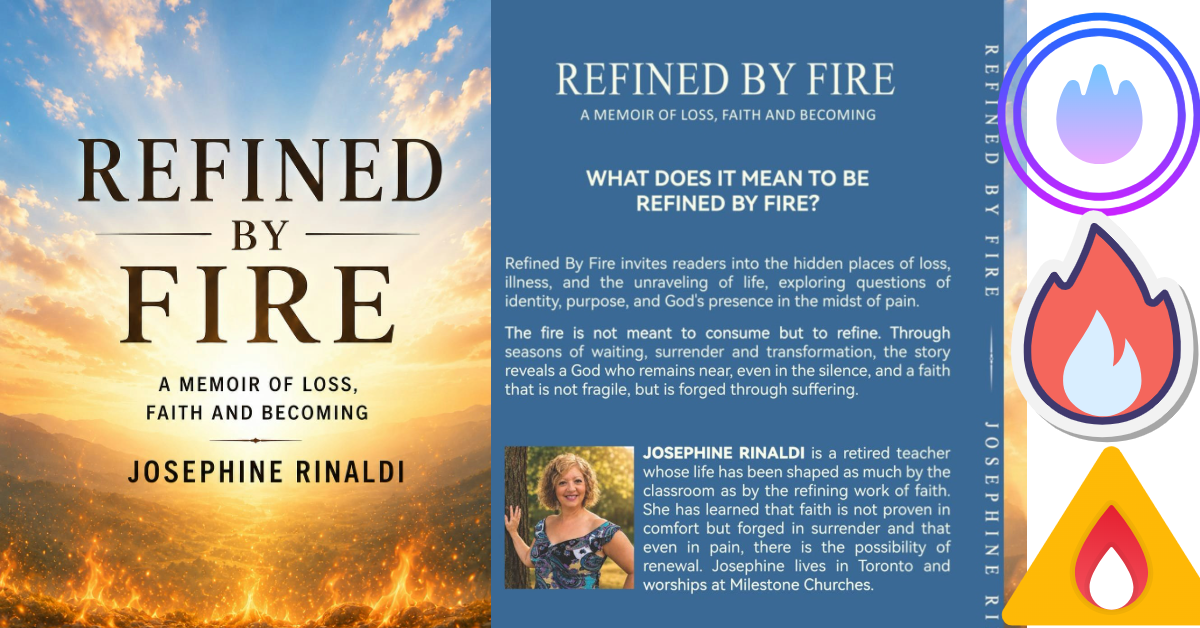
Few phrases capture the journey of the human spirit as powerfully as refined by fire. Found throughout both literature and Scripture, it evokes the image of precious metals transformed through intense heat. In much the same way, life’s greatest hardships, heartbreaks, and trials can shape character, deepen faith, and reveal an inner strength that might otherwise remain hidden.
Donna Leon, in A Refiner’s Fire, explores the ghosts of war, military honor, and the moral ambiguity of redemption. Sylvia Bambola in Refiner’s Fire investigates conscience and the survival of two separated brothers. For Carl Jung, ‘refined by fire’ is an alchemical metaphor where an individual must come face to face with their deep traumas, get rid of their false ego, and embrace their authenticity. Seneca and Marcus Aurelius lean on ‘fire is the test of gold; adversity, of strong men.’ Paige Bishop, in her powerful elegy Refined, talks about breaking generational trauma and personal cycles of pain.
Josephine Rinaldi, author of Refined By Fire: A Memoir of Loss, Faith and Becoming, explores this timeless truth and the remarkable transformation that can emerge from life’s fiercest fires. I love her take on loss, perseverance, and becoming. She wants to assure the reader that hardship does not have the final word. She wants us to look at these challenging experiences as the catalyst that shapes us into people of greater compassion, courage, and hope. I see myself within the pages when she talks about taking care of her father. Her emotions resonate with me as I had to help my mother navigate life after 63 years of marriage. She encourages us that there is life beyond loss, strength beyond suffering, and the possibility of becoming someone wiser, more compassionate, and more resilient than they ever imagined. I respect her story about walking through hardship and finding meaning in the midst of pain, suffering, disappointment, and that life is brutally unfair.
The title Refined by Fire is both powerful and evocative. What “fire” in your life ultimately became the catalyst for the woman you’ve become today?
The fire that shaped me was never one single event. It came in waves over many years, each one testing my strength in a different way. A traumatic brain injury altered the course of my life. Caring for my mother through her long battle with Alzheimer’s, losing both of my parents, and eventually saying goodbye to the family home where so many memories had been made forced me to let go of the life I once knew. There were days when grief felt unbearable and uncertainty clouded every step forward. More than once, I wondered whether I would ever feel like myself again.
Looking back, I realize those experiences did more than break my heart—they reshaped it. They taught me that resilience is not about pretending to be strong but about choosing to keep going, even when the path ahead is unclear. Healing came slowly, often in ways I didn’t recognize at the time. I discovered that growth is rarely comfortable, but it is often born in the very places where we feel most broken. Refined by Fire is the story of that journey.
Writing about grief and loss often means revisiting painful memories. Was there a particular chapter that was especially difficult to write, and how did you know you were ready to share it with the world?
The most difficult chapters to write were Chapters 6 and 7 because they required me to relive some of the darkest seasons of my life. As I wrote, I found myself returning to emotions I thought I had already worked through. There were days I had to step away from the manuscript because the memories felt overwhelming, yet I knew I couldn’t tell an honest story without walking through them again. I wasn’t ready to share those chapters until I realized they were no longer written from the place of my deepest wounds, but from the perspective of healing. The pain had not disappeared, but it no longer defined me. If my willingness to be vulnerable helps even one person feel less alone, find hope, or believe that life can be rebuilt after loss, then every difficult page was worth writing.
Writing those chapters also taught me something unexpected. Healing is rarely a straight line. There were moments when I questioned whether I should include certain memories at all, wondering if they were simply too personal or too painful. But I came to understand that our stories are often where others find the courage to face their own. I didn’t want to write a memoir that I portrayed a perfect life or offered easy answers. I wanted to write something honest—something that acknowledged grief, loss, disappointment, and resilience with equal sincerity.
Your memoir beautifully intertwines heartbreak with faith. During your darkest moments, was there a specific Bible verse, prayer, or spiritual experience that became an anchor for you?
During my darkest seasons, one passage of Scripture became an anchor that I returned to again and again is James 1:2–4: “Consider it pure joy, my brothers and sisters, whenever you face trials of many kinds, because you know that the testing of your faith produces perseverance. Let perseverance finish its work so that you may be mature and complete, not lacking anything.”
At first, I struggled to understand how anyone could consider trials a source of joy when life felt so overwhelming. I did not find joy in the pain itself, but I began to understand that suffering could have a purpose. The verse reminded me that perseverance is often developed in the places where we feel the weakest, and that even the hardest chapters of our lives can shape us in ways we never imagined.
Many people who experience profound loss struggle with questions like “Why me?” or “Where is God in all of this?” How did your relationship with God change throughout the journey you describe in the book?
There were seasons when I felt overwhelmed by grief and wondered how I would find my way through the pain. Losing my mother after years of caregiving, watching my father struggle after her passing, facing my own health challenges, and experiencing the many unexpected changes life brought me tested the foundation of my faith. Yet, in those moments when I felt the weakest, I began to recognize that I was not walking through the fire alone.
My relationship with God became less about understanding every circumstance and more about learning to surrender my need for answers. I discovered that faith grows, not only in moments of joy and celebration, but also in the valleys where we are stretched, refined, and transformed. The difficulties I faced did not disappear, but they changed the way I saw myself, others, and the journey I was on.
As readers follow your story, they’ll meet different versions of you. Looking back, what would you say to the younger Josephine who was just beginning to walk through those painful seasons?
If I could sit with the younger Josephine who was just beginning to walk through those painful seasons, I would tell her to hold on, even when the road ahead feels uncertain. I would tell her that the challenges she would face would not be the things that would defined her, but the experiences that would shape her into a woman of greater compassion, resilience, and strength. I would remind her that it is okay to grieve, to ask questions, and to take time to heal. Growth does not always happen in the moments of victory; often, it is forged in the quiet places of struggle.
I would tell the younger Josephine to not be afraid of the refining process. The losses, disappointments, and unexpected turns would leave their mark, but they would also reveal her capacity to love, to forgive, and to rise again. One day, she would look back and realize that the very moments she thought would break her became the moments that transformed her. They would uncover her purpose, deepen her compassion, and reveal the beauty of becoming the woman she was always meant to be.
Your memoir is incredibly honest and vulnerable. Did you ever hesitate to include certain stories because they felt too personal, and what ultimately gave you the courage to leave them in?
There were moments while writing when I had to stop because the memories were still so powerful. Revisiting the pain of losing my parents brought back waves of grief, but it also reminded me of the depth of love we shared. My mother’s long journey with Alzheimer’s and my father’s struggles after her passing were chapters I carried in my heart for years. Putting those experiences into words was not easy, but it became a way of honoring their lives and the impact they had on mine.
I also learned that vulnerability can be a gift. The moments when I felt the most broken—the nights of tears, the unanswered questions, and the seasons when I felt alone—were the very moments that shaped my strength and character. Whether someone sees those moments through the lens of faith or simply through the human experience of suffering and healing, I hope readers recognize that they are not alone in their struggles.
Loss affects not only the person experiencing it but also family, friends, and faith communities. How did the people around you shape your healing, for better or for worse?
Healing is rarely a journey we take alone. Some people became a lifeline when I couldn’t find the strength to stand on my own. Family members, faithful friends, members of my church community, and compassionate professionals reminded me that I didn’t have to carry my grief in isolation. Sometimes their presence spoke louder than words. A phone call, a meal, a hug, or simply sitting with me in silence gave me the courage to face another day.
At the same time, not every response brought comfort. Some people avoided me because they didn’t know what to say. Others offered well-intentioned advice that unintentionally minimized my pain or expected me to “move on” before I was ready. I learned that grief makes people uncomfortable, and that discomfort can create distance. Those experiences were painful, but they also taught me to extend grace, recognizing that most people were doing the best they could with what they understood.
Looking back, I realize that healing grows in the presence of compassion, patience, and genuine connection. Whether through faith, friendship, or simple human kindness, the people who stayed beside me helped restore hope when I had lost sight of it. Their love reminded me that even in life’s darkest seasons, we are not meant to walk alone. Sometimes the greatest gift we can offer someone who is hurting is not the right words, but the willingness to remain present.
The word “becoming” in your subtitle suggests that healing isn’t a destination but a journey. What does “becoming” mean to you today, and how has your understanding of it evolved since the events in the memoir?
One of the greatest lessons I’ve learned is that becoming requires surrender. We cannot change what has happened to us, but we can choose how those experiences shape us. For a long time, I wanted answers to every loss and every disappointment. Now, I’ve come to accept that some questions may never be answered this side of eternity. Rather than living in the “why,” I’ve learned to focus on the “what now?” That shift has opened my heart to new opportunities, deeper relationships, and a greater appreciation for the ordinary moments that once seemed insignificant.
Becoming has also taught me that strength often looks different than I imagined. It isn’t pretending everything is fine or hiding behind a smile. Real strength is allowing yourself to grieve, asking for help when you need it, and continuing to move forward even when the path is uncertain. I’ve discovered that resilience is built one decision at a time, one day at a time, and often one prayer at a time. Those small, faithful steps eventually become a life marked by perseverance and hope.
What do you hope someone who is currently walking through grief, disappointment, or spiritual uncertainty will feel after turning the final page of Refined by Fire?
I hope that when someone turns the final page of Refined by Fire, they will close the book feeling less alone. Grief has a way of convincing us that no one truly understands the weight we carry, but I want readers to know that healing is possible, even if it comes more slowly than we expect. Pain may change us, but it does not have to define us forever.
I also hope readers leave with a renewed sense of courage. Life will bring seasons of loss, disappointment, and unanswered questions, yet those seasons can become places of unexpected growth. Whether your strength comes from faith, from the love of others, or simply from choosing to take one more step each day, hope can coexist with heartache. I have learned that resilience is not about pretending to be strong—it is about continuing to move forward, even when your heart is broken.
Were there moments while writing when you discovered something new about yourself, even though you had already lived the experiences?
One of the greatest surprises in writing Refined by Fire was realizing that living through an experience and truly understanding it are not the same thing. As I revisited painful memories, I began to see patterns I had missed while I was simply trying to survive. I discovered that I was stronger than I had ever given myself credit for, not because I never broke, but because I kept getting back up. I also recognized that healing isn’t a straight line. It unfolds layer by layer, often revealing new insights when we are finally ready to face them.
Writing became more than telling my story; it became part of my healing. It gave me the opportunity to look at my life with greater compassion instead of criticism.
One of the most profound discoveries I made was that grief had changed me, but it had not destroyed me. As I wrote about the loss of my parents, the challenges of caregiving, my own seasons of brokenness, and the moments when I wondered how I would keep moving forward, I saw evidence of resilience that I had overlooked. I realized that even in my weakest moments, there was a quiet strength growing within me. My story was not only about what I had lost; it was also about what I had gained—the ability to have greater compassion, a deeper understanding of others’ pain, and a renewed appreciation for the preciousness of life.
Faith memoirs often encourage readers without pretending life has easy answers. How did you balance telling the truth about suffering while still offering hope?
As I reflected on the painful chapters of my life, I realized that hope does not erase suffering—it transforms the way we carry it. There were seasons when I felt broken, overwhelmed, and unsure of how I would move forward. Walking through the loss of my parents, the challenges of caregiving, my own struggles with health, and the unexpected changes life brought, I learned that healing is not about forgetting what happened. It is about allowing those experiences to shape us without allowing them to define us.
My faith became an important part of my journey, but I also understand that not every reader will have the same beliefs or experiences. I wanted my story to create a space where anyone who has faced loss, disappointment, or uncertainty could find something meaningful. The emotions of grief, the longing for purpose, and the desire to find peace are universal. My hope is that readers see their own stories reflected in mine and recognize that even in the darkest seasons, they are not alone.
I do not have all the answers, but I have learned that hope can exist alongside heartache. Sometimes the greatest transformations happen not when the fire is removed, but when we discover who we are becoming as we walk through it.
If readers remember just one lesson from Refined by Fire five years from now, what do you hope it will be, and why is that message so close to your heart?
One of the greatest lessons I have learned is that transformation often happens in the places we would never choose to go. The difficult seasons of my life—the losses, the challenges, and the moments when I felt completely overwhelmed—were not wasted. They became the places where I discovered courage I did not know I had and a deeper understanding of compassion, perseverance, and grace. Looking back, I can see that the woman I am today was shaped not despite those experiences, but through them.
I also hope readers understand that healing is not a straight line. There are days when we feel strong and days when old wounds resurface. Becoming is a lifelong journey, and it requires patience, honesty, and the willingness to embrace each step along the way. My hope is that someone who is grieving, struggling, or questioning their own journey will close the pages of this book and realize they are not alone.
Ultimately, Refined by Fire is a story of hope. It is a reminder that broken pieces can be transformed into something beautiful, much like the art of kintsugi, where cracks are not hidden but honored. Whether readers see their journey through the lens of faith or through the resilience of the human spirit, I hope they walk away believing that their story is not over. There is still purpose ahead, and there is always the possibility of becoming something new.
The timing of this book is great. Josephine has stated her heart in a dynamic and yet relatable way.
Such a powerful message! Life’s difficult seasons can truly test us, but they can also shape our character, strengthen our faith, and reveal just how resilient we can be. I love the reminder that sometimes we come through the fire stronger, wiser, and more refined than before.